Research (for specialists)
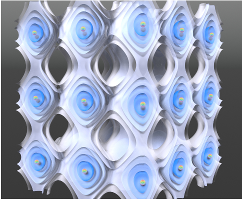
Ultracold atoms, molecules, ions, and photons are incredibly clean, tunable, and unique many-body systems. Experimental tools enabled by decades of progress understanding and engineering light-matter interactions allow experimentalists to tunably realize a huge variety of Hamiltonians and quantum states.
One thread of my research revolves around the fact that one can engineer many-body systems described by canonical models of condensed matter physics. I find ways to use cold atom "quantum simulations" of these models to solve open, important problems in other fields of physics, such as condensed matter. This includes schemes to extract information about these systems, to engineer broader varieties of models, and to reach important phases of matter or nonequilibrium behaviors. I'm especially interested in behavior that is beyond the remarkably successsful Fermi liquid/broken symmetry lines of thought. Prominent examples are quantum critical points and exotic phases such as topologically ordered states and gapless spin liquids. I am also interested in more than mimicking known phenomena, but in exploring the new phenomena that ultracold matter can display unavailable elsewhere in nature.
Another thread revolves around using the advanced capabilities of atomic and molecular optics to generate quantum states that enable capabilities unavailable to classical systems. One example is squeezed states, which are useful for metrology or sensing beyond the standard quantum limit. Another example involves quantum communication and computation. I am particularly interested in finding other classes of resources that may be created without requiring the full technology of a quantum computer implemented in each physical system.
Below, I describe a few problems the group has studied. It's hopelessly out of date, but it still gives an impression of our interests.
Polar molecules
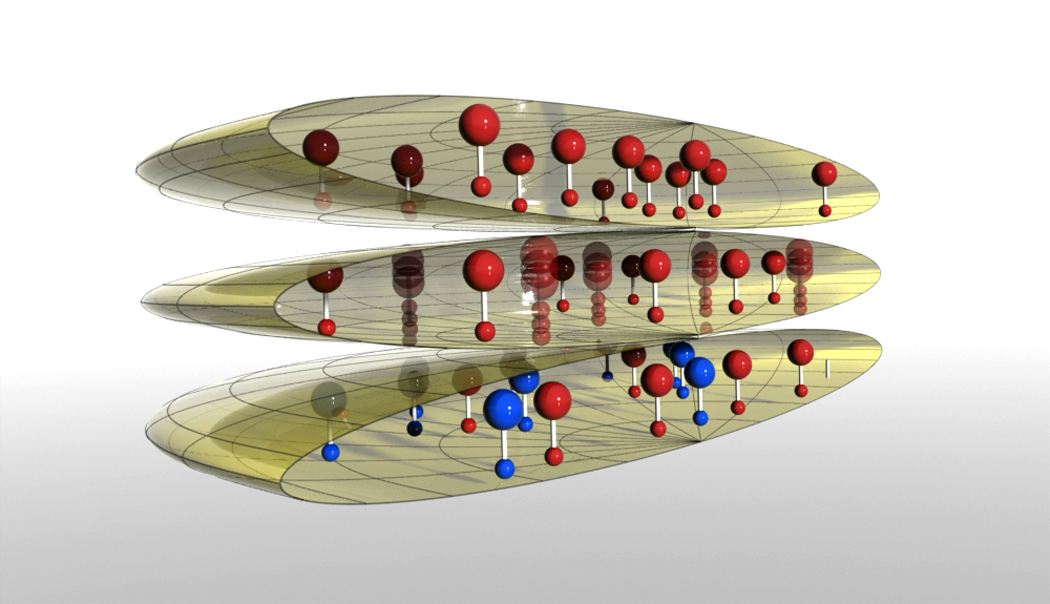
Ultracold polar molecules are a recent addition to the ultracold family. Far more than just "another degenerate system," polar molecules may offer transformative capabilities to emulate many-body quantum magnetism. They also promise applications in quantum information and precision measurement of fundamental quantities.
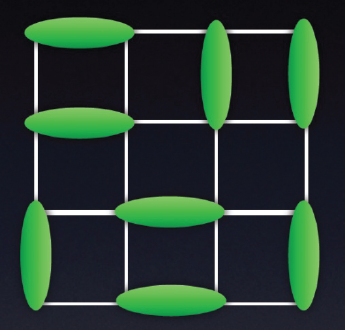
Two properties underly these possibilities. First, molecules possess many long-lived internal states (rotational, vibrational, hyperfine, and electronic), which can mimic spin degrees of freedom. Second, dipolar interactions give strong spin-spin interactions, orders of magnitude larger than their superexchange-driven analogs in atomic systems. Furthermore, we have shown that by applying microwaves and dc electric fields one can realize an incredible range of models: e.g. XYZ or SU(N) Heisenberg models, compass-like models possessing "symmetry protected topological" phases, and -- at least if one possesses enough faith in the eventual experimental capabilities! -- the Kitaev model.
More immediately, we have shown how ongoing experiments -- even if non-degenerate and in sparsely occupied lattices -- can use far-from-equilibrium dynamics induced by experimentally routine Ramsey spectroscopy to benchmark quantum emulation of models, create useful entangled states, and explore novel regimes of dynamical behavior. The JILA Research Highlight "Model Behavior" gives a broad overview of this work. We have also studied Rabi spectra as a diagnostic tool. We have continuing collaboration with Jun Ye and Debbie Jin on thhse and other topics.
Trapped ions
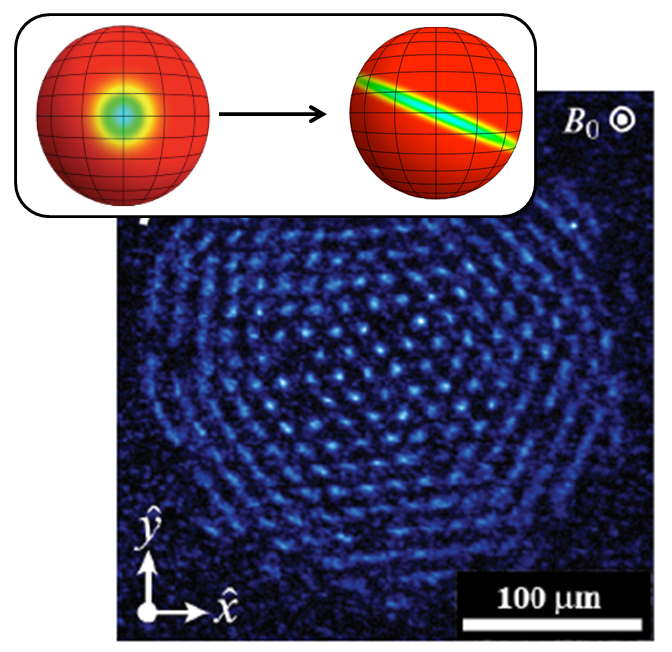
Trapped ions are a relatively mature platform for quantum science. They enable for example, incredibly precise atomic clocks (losing only one second in billions of years) and quantum information processing, for example realizing two-qubit gates with greater than 99% fidelity. Because ions are charged, they interact via strong Coulomb interactions, leading to favorable energy scales for cooling and length scales for imaging and manipulation.
Recently, these tools have been applied to quantum emulation, especially of spin models. Electron spin, electronic, or hyperfine levels can function as spins while interactions are mediated through vibrations of the Coulomb crystal. Chris Monroe and Rainer Blatt's groups are at the forefront of these experiments on typically 5-15 ions. A particularly exciting development has been Penning trap experiments by John Bollinger's group at NIST-Boulder applying this to crystlas of 100-300 ions. At this number of particles, the properties are far beyond what theory can generally treat exactly, and we expect to learn much.
Motivated by this surge of experiments we are developing theoretical techniques for these systems' many-body behavior. One advance has been the first solution of an interacting many-body problem with local decoherence, which remarkably is for the same model describing the simplest ion trap experiments. We are now extending this to even more exciting regimes and devising better ways to produce useful quantum states.
Alkaline earth atoms
Experimentalists can now cool alkaline earth-like atoms (e.g., Sr, Ca, Yb) to quantum degeneracy. Due to their special electronic structure, these have unique applications to quantum emulation, atomic clocks and quantum information. For example, they can realize SU(N) symmetric spin interactions for N as large as 10. The Hilbert space for N=10 is the same as a spin-9/2, but rather than becoming classical for large N the SU(N) symmetry keeps quantum fluctuations important. As one dramatic example, in the large-N limit, these can realize topologically ordered chiral spin liquids.
I have explored the presently experimentally
relevant "high temperature" regime where temperature > tunneling. Remarkably, we found that if one
adiabatically loads a lattice fixing initial gas conditions in an
experimentally relevant way and increases N, the states obtained become
substantially colder, even relative to interesting scales (e.g. the Mott gap). To explore
the behavior and especially to what extent this effect persists to lower
temperature, we considered one-dimensional systems where specialized techniques apply
(e.g., Bethe ansatz, bosonization, DMRG, and sign-problem-free QMC).
Remarkably, in one dimension we found that the decrease in temperature with
increasing N not only continued to apply to low temperatures
(temperature << tunneling), but
became more dramatic!
In conjunction, we
thoroughly studied the correlations, entanglement, and quantum state
properties of the T=0 phases and phase transitions.
See the
JILA Research Highlight "New Flavors of Quantum Magnetism" for another broad
perspective on this work.
Far from equilibrium dynamics
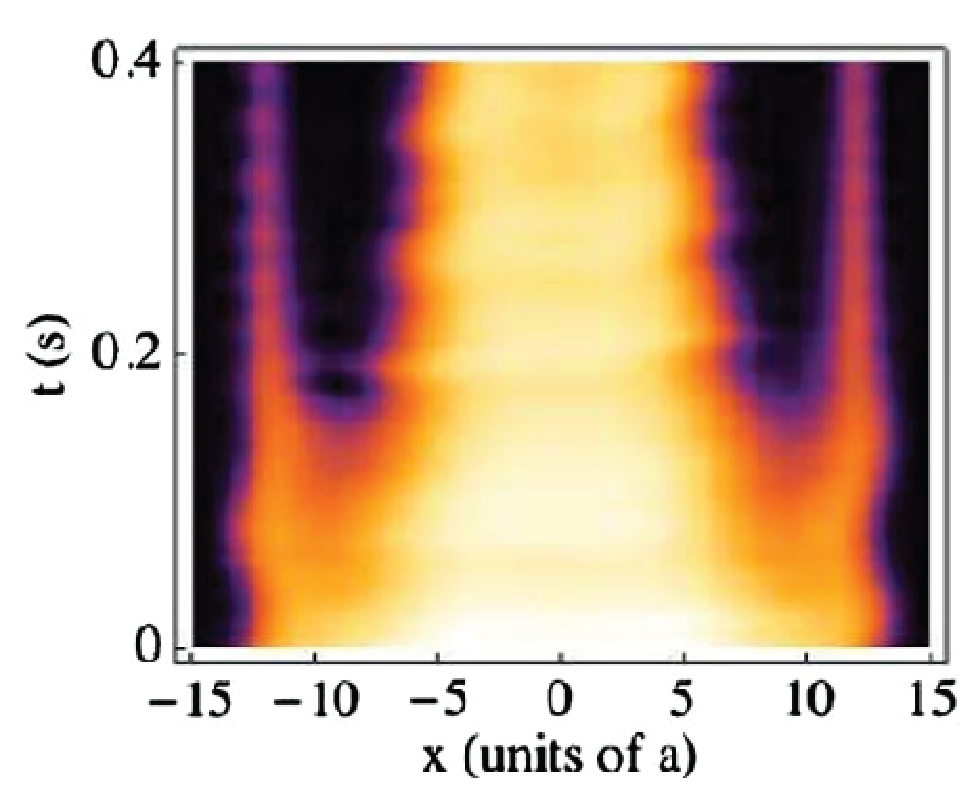
Isolated from their environment, ultracold systems are governed by quantum
coherent dynamics over very long timescales (seconds) compared to their
microscopic timescales (milliseconds). At the moment non-equilibrium
phenomena are understood on a case-by-case basis, so my choice of problems
is experimentally motivated. One problem I studied with Stefan Natu
concerned the
mechanism for equilibration in standard lattice ramps used to
create bosonic Mott insulators, with particular focus on reconciling
experimental observations. A simple but powerful time-dependent Gutwiller
mean field theory illuminated that two timescales govern the dynamics: a fast
(~ms) timescale for local relaxation and a long (~1s) timescale for transport.
This is a generic, hydrodynamic feature and has implications for creating
equilibrium states in general lattice experiments. I also am working on
explaining the anomalously slow expansion observed by Dan Stamper-Kurn's
group when tunneling is suddenly turned on in a one-dimensional lattice of
two-dimensional pancakes, with one pancake initially occupied. Using nonequilibrium Green's function
methods, we find that qualitatively this may be a form of self-trapping
(unpublished).
Quantum criticality
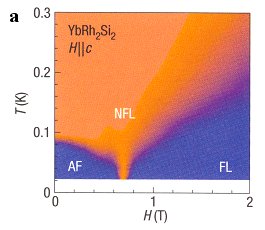
I believe that one of the most promising ways to explore "beyond quasiparticle" matter with cold atoms is to focus on quantum critical points. A zero temperature phase diagram may display a phase transition, in which case the quantum critical point controls the dynamics in a large "fan" of the finite temperature phase diagram. The physics in this fan is not of the usual quasiparticle form: for example, the simple poles in the response functions may be replaced with various kinds of branch cuts. So far, the finite temperature properties controlled by these points has received little attention within the cold atoms community, perhaps due to concerns about studying criticality with relatively small numbers of particles (10^5) and the harmonic trap, or due to the limitations in probing these systems. Because cold atoms lack the usual transport probes, I am presently thinking about how quantum critical behavior observably manifests itself here. I have showed that this physics persists in harmonic traps and one can actually exploit the harmonic trap to observe quantum critical phenomena.
RF spectroscopy of lattice bosons
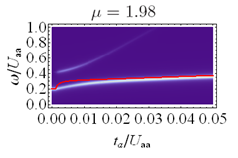
The Bose-Hubbard model's superfluid-Mott insulator phase transition is arguably the simplest realistic and non-trivial quantum phase transition. This phase transition is realized by ultracold bosons in an optical lattice and its properties have been explored in dimensions d=1,2,3 by several groups, notably by Immanuel Bloch at Mainz with Markus Greiner (now at Harvard), at ETH Zurich by Tilman Esslinger at Maryland by Trey Porto and William Phillips, and at MIT by Wolfgang Ketterle. Because of its relatively simple theoretical nature (compared to vexing fermionic and frustrated spin models), it is an ideal place to develop theoretical and experimental ideas for use in future, less understood realms. One such tool we have been thinking about is rf spectroscopy, in which an atom absorbs a low-momentum photon to change its internal state. Campbell et al. experimentally demonstrated this to be a useful in-situ probe of the Bose-Hubbard model's density profile. We presented an initial sum rule analysis of this experiment that captured the essential features and showed that the dominant physics in these experiments is really the average two particle correlations. Since then, we have found that even this simple model contains surprisingly rich physics, and that the RF spectroscopy can directly reveal distinctly different types of correlations in the superfluid near the Mott insulator (see also our paper).
Lattices with strong on-site correlations
I am studying the effects of increasing interaction strengths (scattering length) in cold atomic gases in optical lattices: more than simply increasing the Bose-Hubbard interaction scale, it introduces extra important terms in the lattice Hamiltonian required to describe this system. The basic idea is that if the scattering length is comparable to the interparticle spacing on a site then the wavefunction for two or more particles on a site does not simply factor into a product of single particle wavefunctions. For example, repulsive interactions spread out the wavefunction in a site filling-dependent way, causing a particle-conditioned hopping rate. This alters the shape of the phase diagram.
of the phase diagram.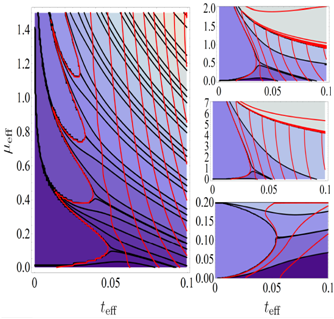
We have argued that these effects are important for several ongoing experiments and qualitatively calculated the model parameters: (1) Already at the small scattering lengths in ongoing 87Rb experiments there are quantitative modifications. These are even more important for other atomic species --- Na, Cs, Yb, etc. --- in both bosonic and fermionic gases. One must account for this in ongoing efforts to quantitatively emulate condensed matter modelss, e.g. the Fermi-Hubbard model, with cold atomic gases. (2) Particle-number conditioned hopping is necessary to describe rapidly rotating sites, which earlier we proposed as a means to create fractional quantum Hall puddles at each lattice site. (3) Finally, attractive bosons' atomic superfluid to molecular superfluid quantum phase transition has attracted much theoretical attention, with proposals to use lattices to stabilize the gas; if the transition is driven via a Feshbach resonance, it is again crucial to include our particle conditioned hopping. We have ongoing efforts to turn our qualitative calculations of the Hamiltonian parameters into quantitative ones using path integral Monte Carlo methods in collaboration with John Shumway.
Quantum solids and liquids in low temperature physics
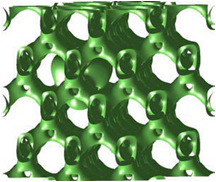
Quantum solids are solids for which the zero-point vibrations are important. Atoms' locations are fundamentally fuzzy due to quantum fluctuations, and additionally atoms may tunnel through several lattice sites. These systems are often messy, involving unknown frozen-in disorder. For this price in ease of analysis one obtains a richness in their behavior. These systems show varieties of orbital ordering, spectral anomalies, possible supersolidity, and glassy quantum dynamics --- as in solid molecular hydrogen, atomic species trapped in solid molecular hydrogen, solid 4He , and "quantum gels," respectively. Some unpublished work can be found in my thesis. Cornell has a wonderful group of low temperature experimentalists, and discussions with Dave Lee, John Reppy, and their groups have been especially fun.
and their groups have been especially fun.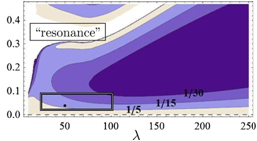
I also worked on a related subject that grew out of discussions with Dave Lee and Sergei Vasiliev on quasi-2D atomic hydrogen. This is invariably adsorbed on He films, and we found that the He film's dynamic excitations ("ripplons") mediate a weak, attractive interaction. In 2D, this leads to dramatic renormalizations of the two-particle correlations. We proposed this as a consistent explanation of observed spectral anomalies. Later investigations revealed that a simpler symmetry-based mechanism probably is behind the spectral anomalies, but we expect the physics of the renormalized two-particle correlations to be remain important for other reasons, for example causing a low temperature collapse of the gas. We also explored anomalous spectra in solid molecular hydrogen populated with atomic hydrogen defects.
Real materials and other past research
In reverse chronological order, I have done some work in: spin-orbit coupling in carbon nanotubes, defects in semiconductors and metals, novel simulation algorithms (mainly accelerated Monte Carlo for computing novel quantities such as transition rates), strongly correlated electrons, quantum computing, and scientific feature mining and visualization... Most of these are represented in my publication list.